# Type classes
Type classes can be applied to properties, link types, and action types. With the exception of the `analyzer` type class kind, which affects [indexing](../../object-indexing/overview/index.md) behavior, type classes define additional metadata that can be interpreted by user applications that interact with the Ontology. For example, the specification of some `hubble` property type classes affects how the property value is rendered in [Object Views](../../object-views/overview/index.md).
The chart below provides a list of known type classes. The columns in this chart are as follows:
* The **Deprecated** column indicates whether a type class is still supported.
* The **Deprecated** column also indicates whether a type class should now be configured in the **Capabilities** page.
* In the Ontology Manager, object types now have a **Capabilities** page to configure features historically defined as type classes. The configuration of all supported type classes will move to the **Capabilities** page.
* The **Type** column indicates whether the type class is applied to a property, link type (formerly known as relation), or action type.
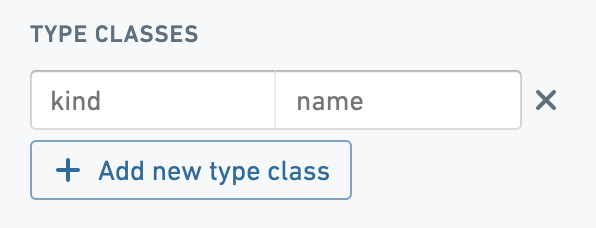
* The **Kind** and **Name** columns contain string values from two user-defined fields that are set when adding a type class in the Ontology Manager. These values are used by Foundry products to label a type class.
 * The **Description** column describes the intended behavior of user applications when interacting with a property value, link, or action for which the listed type class has been added.
* [Object Explorer](../../object-views/overview/index.md) is an application that consumes `hubble` type classes.
* [Quiver](../../quiver/overview/index.md) is an application that consumes `timeseries` type classes.
|Deprecated |Type |Kind |Name | Description |
|--- |--- |--- |--- |--- |
| |Property |hubble |media\_url | Renders the property as a media item when it appears in an Object View. |
|Deprecated |Property |hubble |editable | Allows users to edit the property when it appears in an Object View. Use [inline edits](../../action-types/inline-edits/index.md#object-explorer-inline-edits) instead. |
| |Property |hubble |icon | Indicates that the URL stored as property value contains the icon for an object. |
|Deprecated |Relation |hubble |creatable | Allows the user to create new objects of a specific link type from a Linked Objects View widget within an Object View. The type class is placed on the relation and allows the user to create objects of the type on the "many" side of a one-to-many relation. See [actions](../../action-types/overview/index.md) for the supported way to allow users to create new links. |
|Deprecated |Property |hubble |endorsement\_status:
endorsed | Marks object as `endorsed` in Object Explorer and Object Views when added to the primary key property of an object type. |
|Deprecated |Property |hubble |endorsement\_status:
not\_endorsed | Marks object as `work in progress` in Object Explorer and Object Views when added to the primary key property of an object type. |
|Deprecated |Property |hubble |thumbnail | Uses the URL stored as the property value as a thumbnail in the search results cards.
This was only relevant in a previous version of Object Explorer. |
|Deprecated |Property |hubble |array | This type class was formerly used to ensure that a property is formatted as an array, but arrays are now properly-supported property base types in the Ontology Manager. |
|Deprecated |Property |hubble |default\_sort\_descending | Will automatically sort a column by descending values in Object Explorer.
This was only relevant in a previous version of Object Explorer. |
|Deprecated |Property |hubble |quick\_filter | In Object Explorer list view, these properties were available as default filters.
This was only relevant in a previous version of Object Explorer. |
| |Relation |hierarchy |parent | Signals that the link direction in a link type represents a parent in a hierarchy. Object Views will then display breadcrumbs at the top of the Object View of the hierarchy (e.g., 'Europe -> France -> Paris -> Rue Cler'). |
| |Property |choropleth\_map\_
config\_id |\ | A choropleth can be created for any property type that contains values for geographic regions (i.e., country codes) that can be plotted on a map. The `kind` of type class necessary is `choropleth_map_config_id`, and the `name` depends on what type of region code the property contains.
For instance:
- For countries, use `countries`
- US States → `us_states`
- US Counties → `us_counties`
- US Zip Codes → `us_zip_codes`
For additional region boundary options, or additional assistance with adding this type class, contact your Palantir representative.
Configuration options include changing the type of aggregation as well as the color scale used.
To use this type class, either the `selectable` or `sortable` render hint must be applied to the property. |
|Deprecated |Property |oe\_home\_page\_
object\_type\_group |\ group\_name> | Add this type class to the primary key property of an object type to add said object type to a group.
Ensure proper spelling to avoid the duplication of groups. These configured groups of object types are displayed on Object Explorer's home page.
If you have groups configured, any non-hidden object types you do not add to a group will be placed at the bottom of the page under “Other” group. This has been replaced with the object type groups capability. |
| |Action type |hubble-oe |hide-action | Hides the action type within Object Explorer & Object Views; otherwise they are automatically discovered in the `Actions` button dropdown. |
| |Action type |hubble-oe-object-set-rid | \ | Experimental feature that allows for the creation of dynamic object sets. |
| |Action type |hubble-oe-security-rid | \ | Experimental feature that allows for the creation of dynamic object sets. |
| |Action type |actions |generate\_uuid | Replaces a string parameter with a UUID. |
| |Action type |actions |prefill\_current\_user | Replaces a string parameter with the current user. |
| |Action type |actions |view\_object\_with\_type | Shows the created/modified object in the success toast. |
|Deprecated |Property |analyzer |not\_analyzed | Prevents [Lucene ↗](https://lucene.apache.org/) from tokenizing the property; use for identifier properties that contain dashes, etc.
To configure analyzers, navigate to **Properties > Interaction**, which contains a dropdown for selecting an analyzer.|
|Deprecated |Property |analyzer |simple / standard / whitespace / english / french / japanese / arabic / korean / german / combined\_arabic\_english| Analyzers for specific languages and use cases. Most of these are implemented with Lucene built-in analyzers, but a few are custom plugins.
Korean and German are not supported in the legacy [Object Storage v1](../../object-databases/object-storage-v1/index.md).
To configure analyzers, navigate to **Properties > Interaction**, which contains a dropdown for selecting an analyzer.|
|Deprecated |Property |analyzer |not\_indexed | Prevents Lucene from indexing the property; use for properties that do not need to be searchable or aggregatable.
This type class is no longer used to manage whether a property should be indexed, as this functionality is now managed by the `searchable` [render hint](../metadata-render-hints/index.md). |
|Deprecated |Property |multipass |user\_id | When applied to a property whose values contain Multipass UIDs, the property will be rendered as the users' username (comprised of the multipass:given-name and multipass:family-name attributes) in Object Explorer and Object Views.
This type class is no longer used to ensure a property is formatted as a username, and Multipass UIDs are now supported in the value formatting feature in the Ontology Manager. |
|Deprecated |Property |global |\ | Can be used to mark a property as global. This allows filtering of multiple object types by a common property as long as the properties have the same property\_id and global type class on each object type that should be filtered by this property.
This was only relevant in a previous version of Object Explorer. |
|Deprecated |Property |geo |geojson | Indicates that the property contains GeoJSON data (e.g., polygons, lines, etc.). The [Map application](../../map/overview/index.md) will render this GeoJSON on the map. Deprecated: use the `geoshape` property type instead. |
|Deprecated |Property |geo |latitude | Indicates that the property contains a Latitude for use in the [Map application](../../map/overview/index.md). Deprecated: use the `geopoint` property type instead. |
|Deprecated |Property |geo |longitude | Indicates that the property contains a Longitude for use in the [Map application](../../map/overview/index.md). Deprecated: use the `geopoint` property type instead. |
|Configure in
**Capabilities** page
of object type |Property |geo |altitude | Indicates that the property contains an altitude/elevation, in meters relative to sea level, for use in the [Map application](../../map/overview/index.md) with 3D mode. |
| |Property |vertex |link\_merge | For Vertex & Vortex Related Object Search Arounds, always treat this object as an intermediary - this object will no longer show up in Related Object list, but second-degree links from it will, and it will render as an edge on the graph. Place type class on the primary key of the object. |
| |Relation |vertex |link\_merge\_incoming | The same as `link_merge`, but only for this specific relation - the link merged object is the target/to side of this relation. |
| |Relation |vertex |link\_merge\_outgoing | The same as `link_merge`, but only for this specific relation - the link merged object is the source/from side of this relation. |
| |Relation |vertex |component | For Vertex diagrams, indicates the objects linked to the base objects to be used in the diagram. |
| |Property |vertex |component\_subtype | For Vertex, allows for finer-grained grouping than object type. Place type class on the primary key of the object. |
| |Property |vertex |event\_intent.\ | Set this on the primary key property of an Event to use it in Vertex & Vortex, where `intent` indicates the color/severity of the event/alert (danger, warning, primary, or success). For example: `event_intent.danger` |
| |Property |vertex |event\_value | Indicates the property representing the numeric value of the event. |
| |Property |vertex |event\_value\_unit.\ | Set this alongside `event_value`, where `unit` is the unit of measurement for numeric value of the event. For example: `event_value_unit.Kilograms` |
| |Property |vertex |event\_property | Shows this property in the Vertex & Vortex event cards. |
| |Property |vertex |min | For time series objects: Vertex will alert when series values fall below this minimum. |
| |Property |vertex |max | For time series objects: Vertex will alert when series values exceed this maximum. |
| |Property |vertex |threshold\_measure.\ | For Vertex, set this on the primary key property of an object to indicate which measure to use for thresholding. For example: `threshold_measure.Temperature` |
| |Property |vertex |threshold\_high\_limit | Used in conjunction with `threshold_measure` to indicate which property represents the upper threshold bound. |
| |Property |vertex |threshold\_low\_limit | Used in conjunction with `threshold_measure` to indicate which property represents the lower threshold bound. |
| |Property |vertex |threshold\_exceed\_intent.\ | Set this on the primary key property of an object in conjunction with `threshold_measure`, where `intent` indicates the color/severity of the threshold breach (danger, warning, primary, or success). For example: `threshold_exceed_intent.danger` |
| |Property |vertex |key\_measure.\ | Measures listed here will display on the Vertex home page. For example: `key_measure.Temperature` |
|Deprecated |Property |vertex |enum\_values | For time series objects: A JSON map from numeric values to string values. The type class is no longer supported. |
|Configure in
**Capabilities** page
of object type |Property |timeseries |timeseries\_id | When applied to the primary key of a timeseries object, this type class specifies the *series identifier* (`seriesId`) of that object. The property must be globally unique across all timeseries objects, and is the only type class that is required for your object to be discoverable in Quiver. |
|Configure in
**Capabilities** page
of object type |Property |timeseries |timeseries\_measure | The property specifying the [measure](../../quiver/timeseries-overview/index.md) of a timeseries object.
Note: The `timeseries.timeseries_sensor_type` type class was formerly used for the same purpose; this will continue to work, but use `timeseries.timeseries_measure` for consistency. |
|Deprecated |Property |timeseries |timeseries\_sensor\_type | See `timeseries_measure` above. |
|Configure in
**Capabilities** page
of object type |Property |timeseries |timeseries\_units | The property specifying the *value* units of a timeseries object (e.g., a stock price timeseries might have `dollars` as a value unit). |
|Configure in
**Capabilities** page
of object type |Property |timeseries |timeseries\_internal\_interpolation | The property specifying the default *internal interpolation* of a timeseries object. Internal interpolation is how Quiver infers series values between adjacent data points. |
|Configure in
**Capabilities** page
of object type |Property |timeseries |timeseries\_root\_object\_id | The property specifying the [root object](../../quiver/timeseries-overview/index.md) of a timeseries object. Each timeseries object can only have one root object. |
|Configure in
**Capabilities** page
of object type |Property |timeseries |timeseries\_is\_enum | A Boolean property which must be `true` for any timeseries that has enum values.
Note: This requirement is temporary and may change in the future. |
|Configure in
**Capabilities** page
of object type |Property |timeseries |timeseries\_is\_deprecated | A Boolean property which, when set to `true` for a timeseries, will filter it out of Object Explorer and Object View search results.
Note: This will only post-filter these timeseries out of results in Quiver. This will not affect search results in other applications. |
| |Relation |timeseries |parent | Describes the link between the timeseries object and each parent, similar to `hierarchy.parent`. |
| |Property |timeseries |timeseries\_is\_value\_inverted | When set to true, this boolean property will automatically invert the y-axis values of a timeseries in Quiver, such that values ascend going down. This is useful for plotting a time vs. depth series, such as when tracking the progress of an underground drilling operation over time. |
| |Property |timeseries |timeseries\_depth\_units | Place on the property containing the depth units of complex series (depth series, well completion series and fiber series). The regular `timeseries.timeseries_units` property is used for the value units of a depth series and well completion series. |
|Configure in
**Capabilities** page
of object type |Property |timeseries |event\_id | The property specifying the *event identifier* (`eventId`) of an event object. Should be globally unique across all event objects. |
|Configure in
**Capabilities** page
of object type |Property |timeseries |event\_start\_time | The property specifying the start time of an event object. This field should be a time value (e.g. a `TIMESTAMP)`. |
|Configure in
**Capabilities** page
of object type |Property |timeseries |event\_end\_time | The property specifying the end time of an event object. This field should be a time value (e.g. a `TIMESTAMP)`. |
|Configure in
**Capabilities** page
of object type |Property |timeseries |event\_description | The property specifying the string description of an event object. This is required if the event object type will be used for [annotation writeback](../../quiver/timeseries-overview/index.md). |
|Configure in
**Capabilities** page
of object type |Property |timeseries |event\_root\_object\_id | The property specifying the [root object](../../quiver/timeseries-overview/index.md) of an event object. Each event object can only have one root object. |
|Configure in
**Capabilities** page
of object type |Property |timeseries |event\_linked\_series\_id | The property specifying the [series object](../../quiver/timeseries-overview/index.md) to which an event object relates. String arrays as well as single strings are supported for this field. |